Scalable Cooling Solutions: Is a Rooftop Unit the Right Fit for Your HVAC Maintenance in Winter Park Strategy?
Most Winter Park property managers don't outgrow their HVAC system — they outgrow their cooling strategy. After servicing commercial and multi-unit properties across Central Florida, we've seen the same pattern: split systems that made sense at installation become a maintenance headache as buildings scale. Rooftop units solve that — but only when the match is right. The wrong RTU choice costs more to maintain than the system it replaced. We've worked on enough Winter Park rooftops to know what separates a smart RTU investment from an expensive mistake. This page gives you that firsthand perspective — so you can make the right call for your property before a technician ever sets foot on your roof.
TL;DR Quick Answers
A rooftop unit can be the right fit for your Winter Park HVAC strategy — but only when three conditions are met:
The sizing is right. Proper load calculation is non-negotiable in Florida's humidity. Oversized RTUs short-cycle and fail to dehumidify — the most common RTU problem we see in Central Florida commercial buildings. Using the right HVAC air filter sizing calculations is a small but critical part of ensuring your system handles the local moisture load effectively.
The building is ready. Flat or low-slope roof with adequate structural capacity and drainage. Existing ductwork compatible with single-point air distribution. No unresolved roof condition issues before installation.
The maintenance plan fits Florida — not national averages. Year-round cooling demand, UV exposure, and humidity accelerate wear faster than manufacturer schedules reflect. Coil cleaning, drain pan inspection, and filter maintenance need Florida-specific service intervals.
RTUs work best for Winter Park properties that need:
Scalable capacity without major infrastructure overhaul
Centralized rooftop maintenance access
Long-term cooling infrastructure built for a growing market
Bottom line: A correctly sized, properly maintained rooftop unit is one of the most effective long-term cooling strategies available for Winter Park commercial properties. The unit is only part of the equation — sizing accuracy and a Florida-calibrated maintenance plan determine whether that investment performs for 15 to 20 years or falls short well before that timeline.
Top Takeaways
Sizing accuracy determines everything. 25% of commercial RTUs are oversized nationally. In Florida, oversizing kills humidity control — not just efficiency. Proper load calculation is the most important step before any RTU goes on your roof.
Florida demands a Florida-specific maintenance plan. National manufacturer schedules aren't built for Central Florida's climate. Year-round cooling, UV exposure, and humidity accelerate wear faster than standard intervals reflect. Service your RTU on a schedule built for this market — not a national average. Implementing annual preventative AC maintenance service care plans in Winter Park ensures your investment stays protected year-round.
The unit is only part of the investment. Roof condition, structural capacity, and existing ductwork determine long-term RTU value. A local property assessment before purchase protects the investment before it's made. The wrong building fit costs more to maintain than the system it replaced.
Scalability is a Winter Park priority — not a luxury. Cooling demand is projected to grow 29% by 2050. Winter Park is one of Florida's fastest-growing commercial markets. RTU infrastructure built for today's load may be undersized for tomorrow's reality.
The right RTU strategy is ongoing — not transactional. Sizing, installation, and maintenance work together as a long-term strategy. Properties that treat RTUs as a one-time purchase pay for it in premature replacements. The finish line isn't installation day — it's 15 to 20 years of reliable performance.
What Is a Rooftop Unit and How Does It Work?
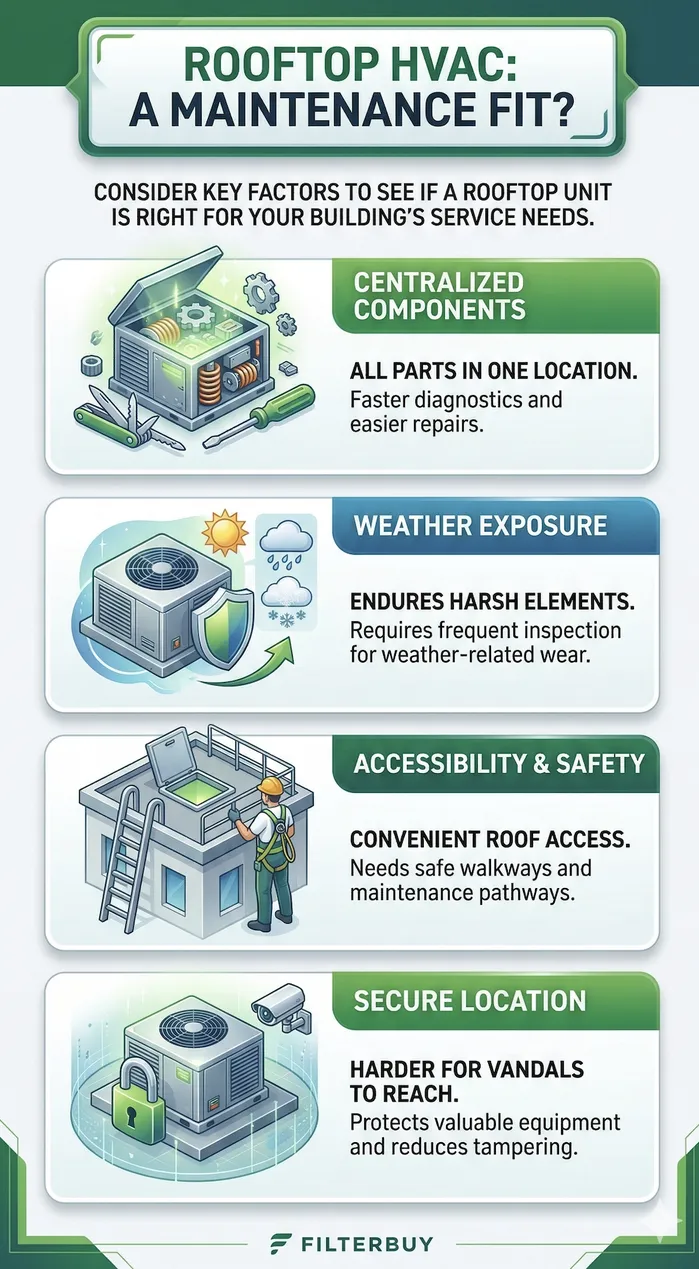
A rooftop unit is a self-contained heating, ventilation, and air conditioning system mounted directly on a building's roof, housing the compressor, condenser, and air handler in a single cabinet. Conditioned air travels through ductwork into the building below. For Winter Park commercial properties, that consolidated design means less mechanical space consumed inside — and a single access point for maintenance.
Why Central Florida's Climate Makes RTU Selection Critical
Winter Park's combination of extreme summer humidity, intense UV exposure, and year-round cooling demand accelerates wear on rooftop equipment faster than in moderate climates. Units sized too small cycle constantly, driving up energy costs and shortening compressor life. Units oversized for the space short-cycle, leaving humidity uncontrolled — a serious problem in Florida's subtropical environment. Proper load calculation isn't optional here. It's the difference between a system that lasts 15 years and one that needs replacement in eight.
Where Rooftop Units Outperform Traditional Split Systems
RTUs deliver clear advantages in the right application:
Scalability — Additional zones or units can be added without overhauling existing infrastructure
Centralized maintenance — All components are accessible from one rooftop location, reducing service time and labor costs
Interior space preservation — No indoor mechanical room required, freeing usable square footage
Simplified ductwork — Single-point distribution works efficiently in open floor plan commercial layouts
For Winter Park retail centers, office buildings, and multi-tenant properties, these advantages translate directly into lower long-term operating costs.
Where RTUs May Not Be the Right Fit
Rooftop units aren't the universal answer. Residential properties and smaller commercial spaces often find top residential HVAC air conditioning installation services company cost prices near Port St Lucie or similar split systems more cost-effective. Buildings with flat roofs lacking proper drainage create standing water issues that accelerate RTU corrosion. Historic properties or those with rooftop load restrictions may face structural barriers. If your Winter Park property falls into any of these categories, an RTU investment may create more problems than it solves.
RTU Maintenance Requirements in a Florida Climate
Owning a rooftop unit in Central Florida means committing to a proactive maintenance schedule. Coil cleaning is non-negotiable — Florida's airborne debris, pollen, and humidity cause rapid coil fouling that chokes efficiency. Drain pan inspections prevent the mold growth that humid conditions accelerate. Electrical connections require hvac-tune-up-coral-gables-fl.com seasonal checks as thermal expansion from Florida's heat cycles loosens components over time. Belts, bearings, and filters need more frequent attention here than manufacturer schedules designed for moderate climates suggest. A twice-yearly professional maintenance plan isn't a luxury for Winter Park RTU owners — it's what protects the investment.
How to Evaluate If an RTU Fits Your Winter Park HVAC Strategy
The right RTU decision starts with an honest property assessment:
Building size and layout — Open commercial spaces with existing ductwork are ideal candidates. It is also helpful to consider everything you need to know about 14x18x1 air filters to understand how filtration impacts these large-scale systems.
Roof condition and load capacity — Structure must support unit weight and service personnel access.
Current system performance — Are you experiencing capacity limitations, uneven cooling, or escalating repair costs?
Budget horizon — RTUs carry higher upfront costs but lower long-term maintenance expense in the right application.
Expansion plans — If your facility is growing, scalable RTU infrastructure pays dividends over time.
A qualified local HVAC technician familiar with Winter Park's building stock and climate conditions should walk your property before any RTU decision is finalized.
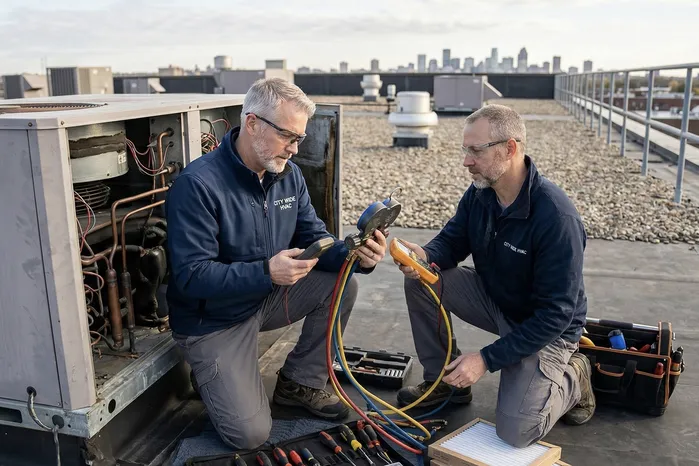
"In our experience servicing commercial properties across Winter Park and Central Florida, the RTU installations that perform best long-term aren't just about picking the right unit — they're about matching the system to the building's actual load profile and committing to a maintenance schedule built for Florida's climate, not the manufacturer's baseline assumptions."
7 Expert Resources for Winter Park Commercial HVAC Planning
Making a smart rooftop unit decision for your Winter Park property means going beyond the sales pitch. After years of servicing commercial buildings across Central Florida, we've seen firsthand how the right information upfront prevents costly mistakes down the road. These are the resources we point our own clients to when they're evaluating whether an RTU is the right fit for their building.
ASHRAE Load Calculation Applications Manual — Size Your RTU Right the First Time
In our experience, improper sizing is the number one reason commercial RTU installations underperform here in Central Florida. This is the industry-standard manual behind every legitimate load calculation — and the benchmark we use when assessing whether a system is truly matched to a building's demand. ???? https://www.ashrae.org/technical-resources/bookstore/load-calculation-applications-manual
ASHRAE Standard 183 — The Technical Foundation Behind Every RTU Sizing Decision
This is the engineering standard that separates a properly sized rooftop unit from an expensive mistake that short-cycles through Florida summers. It establishes the minimum requirements for peak cooling and heating load calculations in commercial buildings — the kind of technical baseline your contractor should be working from before a single unit gets specified. ???? https://tpc.ashrae.org/Functions?cmtKey=ad90e53c-cbc6-46d2-95d1-a63e373601cf
EPA Building Air Quality Guide — Protect the People Inside Your Building, Not Just the Equipment
We genuinely care about what happens inside the buildings we service — and so does the EPA. Developed jointly with NIOSH, this guide helps commercial property owners and facility managers prevent, identify, and resolve indoor air quality problems before they affect occupant health. ???? https://www.epa.gov/indoor-air-quality-iaq/building-air-quality-guide-guide-building-owners-and-facility-managers
ENERGY STAR Light Commercial HVAC — Know What Efficient Looks Like Before You Commit
Space cooling drives roughly 15% of commercial building electricity costs — and in Winter Park's year-round cooling climate, that number hits harder than in most parts of the country. ENERGY STAR certified RTUs run approximately 17% more efficiently than standard equipment. We share this resource because an efficient unit doesn't just save energy — it protects your operating budget every single month. ???? https://www.energystar.gov/products/light_comm_heating_cooling
U.S. Department of Energy — Plan Your RTU Investment Around What's Coming, Not Just What's Here
New federal efficiency standards for commercial rooftop units take effect January 1, 2029, with projected savings of nearly $24 billion in utility costs over 30 years of shipments. As your neighbors in this community, we want to make sure you're planning for the long game — not just the next replacement cycle. ???? https://www.energy.gov/articles/doe-finalizes-four-consensus-based-efficiency-standards-save-americans-billions-utility
Florida Building Code 2023 Energy Conservation, 8th Edition — Make Sure Your Contractor Is Building to Current Code
The 2023 Florida Building Code raised the bar on commercial HVAC efficiency requirements — updated minimums across seven equipment tables and new SEER2 and HSPF2 rating standards are now in effect. We've seen what happens when installations don't reflect current code. Before any RTU work begins on your Winter Park property, make sure your contractor knows exactly what compliance looks like today. ???? https://www.floridabuilding.org/fbc/thecode/2023_Code_Development/2023_Code_Resources/BLDG-124_DBPR_Energy_Code_Changes_Brochure_2023.pdf
EPA Indoor Air Quality in Offices and Large Buildings — Don't Let Your RTU Become an Air Quality Problem
A rooftop unit that isn't properly specified or maintained can turn from a comfort solution into an IAQ liability — and in our climate, that happens faster than most property owners expect. The EPA's guidance on ventilation standards and indoor air quality management for commercial buildings is something we reference regularly, because getting the air right matters as much as getting the temperature right. ???? https://www.epa.gov/indoor-air-quality-iaq/indoor-air-quality-offices-and-other-large-buildings
Supporting Statistics: What the Data Says About Rooftop Units and Commercial HVAC in Florida
Numbers tell part of the story. Firsthand experience tells the rest. Here's what the research shows — and what it actually means for Winter Park commercial properties.
At Least 1 in 4 Commercial Rooftop Units Is Oversized — and That's a Problem Florida Amplifies
According to the Consortium of Energy Efficiency, at least 25% of all rooftop HVAC units are oversized, resulting in increased energy costs and equipment wear. That national figure understates what we see here. In Central Florida, oversizing doesn't just waste energy — it destroys humidity control. Here's what that looks like in a real Winter Park building:
Unit hits the thermostat setpoint too fast
Short-cycles and shuts off before completing dehumidification
Moisture stays in the air despite the space being "cooled"
Tenants crank thermostats lower trying to get comfortable
Energy bills climb — and the equipment wears out faster
Proper load calculation before installation eliminates this scenario entirely. It's the single most important step before any RTU goes on a Florida rooftop. ???? Source: U.S. Environmental Protection Agency — ENERGY STAR Light Commercial HVAC https://www.energystar.gov/products/light_comm_heating_cooling
HVAC Drives 30% of All Commercial Building Energy Costs — Florida Pushes That Number Higher
According to the U.S. Department of Energy, HVAC systems consume approximately 30% of total commercial building energy consumption — with space cooling accounting for 28% of that HVAC load and ventilation accounting for another 29%. What that number doesn't show is the regional reality. In Winter Park, there is no off-season for cooling. That changes everything about how this statistic hits local operating budgets:
Northern commercial buildings get months of natural cooling relief each year
Central Florida properties run cooling systems continuously — year-round
That 30% national average becomes a heavier, more consistent burden here
A unit adequate in a moderate climate becomes a cost liability in Florida's year-round heat
Every RTU assessment we conduct in this market accounts for that reality before a recommendation is made. You can get an hvac air conditioning installation cost price quote free online estimate near Fort Lauderdale FL to see how these costs compare across the state. ???? Source: U.S. Department of Energy — Energy Savings Potential and RD&D Opportunities for Commercial Building HVAC https://www.energy.gov/sites/prod/files/2017/12/f46/bto-DOE-Comm-HVAC-Report-12-21-17.pdf
Cooling Demand Is Growing 29% by 2050 — Central Florida Is Already Living That Future
The U.S. Energy Information Administration projects that U.S. energy consumption for air conditioning will increase 29% between 2020 and 2050, driven by warmer weather trends and population migration to warmer areas of the country. From where we stand in Central Florida, that projection doesn't feel like a forecast — it feels like a description of right now. Winter Park is one of the fastest-growing commercial markets in Florida. The RTU decisions being made today will carry that increased load for the next 20 to 30 years. That means:
Scalability — Your system needs to grow as your building demands grow
Efficiency — Equipment specified for today's load must handle tomorrow's intensity
Durability — Florida's accelerated wear cycle demands a maintenance plan built for this climate, not national averages
Long-term planning — The right RTU strategy isn't just solving today's comfort problem — it's building infrastructure that holds up as regional demand continues to rise
For Winter Park commercial properties, scalability isn't a bonus feature. It's a requirement. ???? Source: U.S. Energy Information Administration — Annual Energy Outlook 2021 https://www.eia.gov/todayinenergy/detail.php?id=47736
Our Final Thought: The Right RTU Decision Is a Long-Term Commitment, Not a One-Time Purchase
After years of servicing commercial rooftops across Winter Park and Central Florida, we've reached a conclusion that rarely makes it into the sales conversation. The rooftop unit itself is rarely the deciding factor. The decisions made before and after installation matter more. We've seen it go both ways:
Well-specified RTUs underperform because load calculations were rushed
Quality units fail prematurely because maintenance schedules ignored Florida's climate
RTU investments pay dividends for decades — when the right questions were asked before equipment ever went on the roof
Here's Our Honest Take After Working in This Market:
Florida doesn't forgive oversizing. A short-cycling RTU in Winter Park's humidity isn't just inefficient — it's actively failing at its core job.
Load calculation is the most important conversation you'll have. Every underperforming system we've diagnosed traces back to a sizing decision that prioritized speed or cost over accuracy.
Maintenance isn't optional in this climate. National manufacturer schedules aren't written for Central Florida's UV exposure, humidity, and year-round cooling demand. Your maintenance plan shouldn't be either.
Scalability is a Winter Park-specific priority. This market is growing. Commercial properties built and retrofitted today will carry significantly higher cooling loads within the next decade.
Our Opinion:
Too many Central Florida property owners treat RTU decisions like transactions — with a finish line. The properties that get the most from their rooftop systems treat it as an ongoing strategy:
Invest in proper sizing upfront
Build a maintenance plan calibrated to this climate
Revisit RTU infrastructure as buildings and occupancy evolve
A rooftop unit is a 15 to 20-year commitment under the right conditions. In Florida, with the right approach, it delivers on that timeline. With the wrong approach, you'll be back on the roof far sooner than planned. That's not a sales pitch. It's what we've watched play out on commercial rooftops across this community for years.
Frequently Asked Questions
Q: What makes a rooftop unit a scalable cooling solution for commercial properties in Winter Park? A: RTUs offer a scalability advantage that most other commercial HVAC systems can't match. Here's why it matters for Winter Park properties specifically:
Each unit is self-contained and roof-mounted
Additional capacity adds without touching existing mechanical infrastructure
Zones expand incrementally — no gut-renovation cost required
Retail centers, office buildings, and mixed-use properties add capacity over years — not all at once
We've worked with Winter Park facility managers who inherited split systems that made sense at original occupancy — and became operational headaches the moment tenant demand grew. RTUs eliminate that ceiling. In a growth market like Winter Park, that flexibility compounds into a long-term operational advantage.
Q: How does Florida's climate affect RTU performance and maintenance requirements compared to other states? A: Florida doesn't just accelerate RTU wear — it exposes every shortcut taken during specification and installation. Here's what we observe servicing commercial rooftops across Central Florida:
Coils that stay clean for a full year in northern climates foul within months here
Drain pans need inspection far more frequently — mold pressure in Florida is constant
Electrical connections loosen faster due to relentless thermal expansion cycles
Two-year-old RTUs here show wear that wouldn't appear for five or six years in moderate climates
The bottom line: National manufacturer maintenance schedules are already behind for Winter Park properties. This climate demands its own service intervals, and maintenance must be performed by technicians who have worked these systems in these conditions. Many owners also look at get the best results with attic insulation installation service to further reduce the thermal load on their rooftop equipment.
Q: How do I know if my Winter Park commercial property is a good candidate for a rooftop unit? A: The strongest RTU candidates in this market share these characteristics:
Building type — Open-plan commercial spaces with flat or low-slope roofs and existing ductwork
Size and layout — Properties where centralized air distribution makes operational sense
Roof condition — Structurally sound roofing with adequate load capacity and drainage
Cooling history — Buildings showing capacity limitations, uneven temperatures, or escalating repair costs
Growth plans — Facilities expecting occupancy or square footage expansion within five to ten years
What we've learned from walking Winter Park properties: Drainage issues that look minor in dry months become corrosion problems within two rainy seasons. Roofs that pass visual inspection but can't support service personnel safely become maintenance liabilities. One overlooked factor during assessment can undermine an otherwise sound RTU investment. A thorough local property walkthrough is the only reliable way to assess RTU fit. A spec sheet comparison won't catch what a site visit will.
Q: What are the most common RTU mistakes Winter Park commercial property owners make? A: After years of diagnosing underperforming commercial HVAC systems across Central Florida, the same five mistakes appear repeatedly:
Skipping proper load calculation. Sizing based on square footage rules of thumb instead of a real load assessment. In Florida's humidity, oversizing is a dehumidification failure — not just an efficiency problem. We've walked Winter Park spaces that were technically cooled but occupants were still uncomfortable.
Applying national maintenance schedules to a Florida system. Manufacturer intervals are written for average national conditions; Central Florida isn't average. Coil cleaning, drain pan inspection, and electrical checks all need to happen more frequently here.
Overlooking roof condition before installation. Drainage issues that look acceptable during a dry assessment become corrosion problems fast. Two rainy seasons of standing water against a unit base causes premature wear. Roof condition must be assessed before — not after — the RTU goes up.
Choosing the lowest bid over lifecycle value. Lower-efficiency units specified to save money upfront often cost more within three years. Energy costs and repair frequency close the gap faster than most property owners expect. Total lifecycle cost matters more than purchase price in Florida's demanding climate.
Treating installation as the finish line. The maintenance strategy after installation determines 15 years of performance or 8. In Central Florida, the unit going on the roof is the beginning of the investment. Without a proactive service plan, RTU lifespan shortens significantly. Owners may also want to compare diy air duct cleaning vs professional services pros and cons in Wellington FL homeowners to decide on the best maintenance approach for their ductwork.
Q: How does a rooftop unit impact indoor air quality in a Central Florida commercial building? A: RTU performance and indoor air quality are inseparable in Florida's climate. A properly sized RTU runs long enough to complete the dehumidification cycle Florida demands. An oversized, short-cycling unit never finishes that cycle — moisture stays in the air. Unchecked humidity in a commercial space accelerates mold growth and degrades occupant health.
What poor RTU performance looks like in a real Winter Park building: musty odors in spaces that are technically cooled and occupant respiratory complaints despite a functioning system. The root cause is often a unit not controlling humidity because it isn't running long enough.
The three factors we check on every commercial service visit that determine RTU air quality impact:
Coil cleanliness — Fouled coils reduce efficiency and compromise air quality simultaneously.
Drain pan condition — Neglected drain pans become mold sources in Florida's humidity.
Filter integrity — Degraded filters allow contaminants into the air stream. Keeping high-quality filters on hand, such as those found in a Filterbuy 20x25x1 MERV 8 Pleated HVAC AC Furnace Air Filters 6-Pack, is essential for system health.
When these three elements are maintained on a Florida-specific schedule, the RTU protects occupant health. When neglected, the same system becomes the source of the problem it was installed to prevent. You might also consider air-ionizer-installation-palm-beach-gardens-fl.com or duct-cleaning-palm-beach-gardens-fl.com for additional air quality support.
Ready to Find Out If a Rooftop Unit Is the Right Fit for Your Winter Park HVAC Strategy?
Our local HVAC specialists have assessed commercial rooftops across Central Florida and know exactly what scalable cooling success looks like in this market — tap here to schedule your free property assessment and get an honest, experience-backed recommendation built specifically for your building.
For those looking for specific replacement parts, you can find a FilterBuy 24x24x2 Pleated Furnace Filters on Amazon, or check options like ebay.com/itm/393226578619 and Filterbuy 18x20x1 air filter 2 pack pleated merv 8 dust defense at Target. For Home Depot shoppers, the Filterbuy 16 in x 24 in x 1 in MERV 8 Dust Defense Pleated Filters are also available. Understanding what does 16x20x1 actually mean nominal vs actual air filter sizing explained can help you select the correct fit. If you are exploring broader installation options, consider the best residential HVAC air conditioning installation services company cost prices near Hialeah FL or 14x18x1-air-filters.com for standard sizing needs.
Learn more about HVAC Care from one of our HVAC solutions branches…
Filterbuy HVAC Solutions - Miami FL - Air Conditioning Service
1300 S Miami Ave Apt 4806 Miami FL 33130
(305) 306-5027
https://maps.app.goo.gl/Ci1vrL596LhvXKU79